

The House Appropriations Committee recently adopted a bill and report that affects NIH and other agencies under the umbrella of “Labor, Health and Human Services, Education, and Related Agencies.”
The bill itself doesn’t say a lot that would be relevant to metascience, with two possible exceptions.
Section 214 of the bill says that the NIH Director can enter into “other transactions” (i.e., a flexible term referring to something other than the usual grants and contracts) to do research under Section 402(b)(12) of the Public Health Service Act.
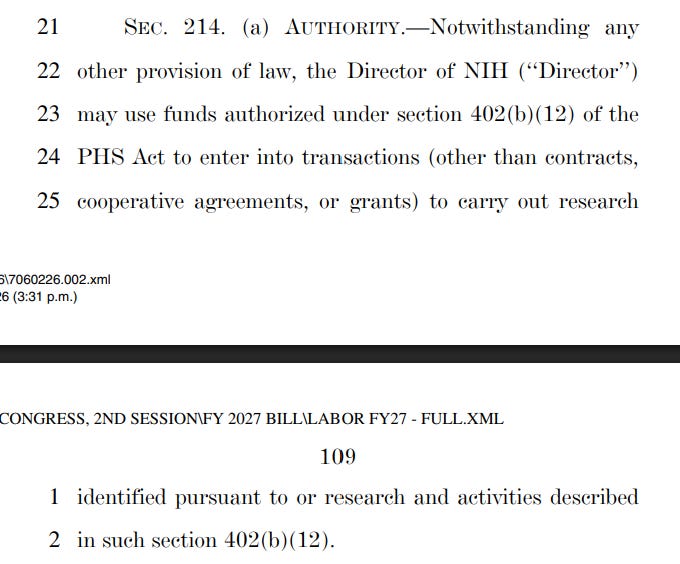
The section says the NIH Director can fund the following stuff:

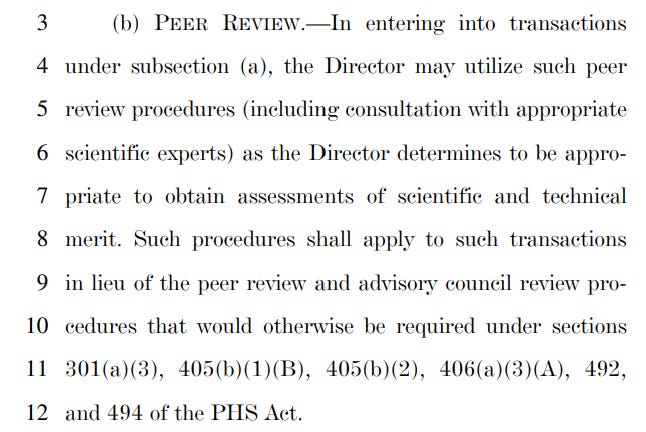
The budget bill then says that the NIH Director doesn’t have to use the normal peer review process in such cases:
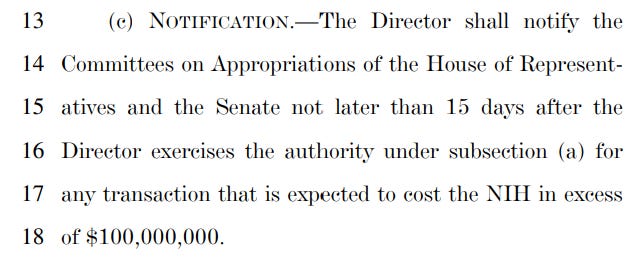
Finally, the NIH Director has to notify Congress if he spends more than $100m on any one transaction:
To be honest, I’m not sure what Congress or the NIH is contemplating here, but it sounds interesting.
Next, Section 223 of the budget says that NIH can’t spend any money on indirect costs above “30 percent of an award” going to privileged universities:
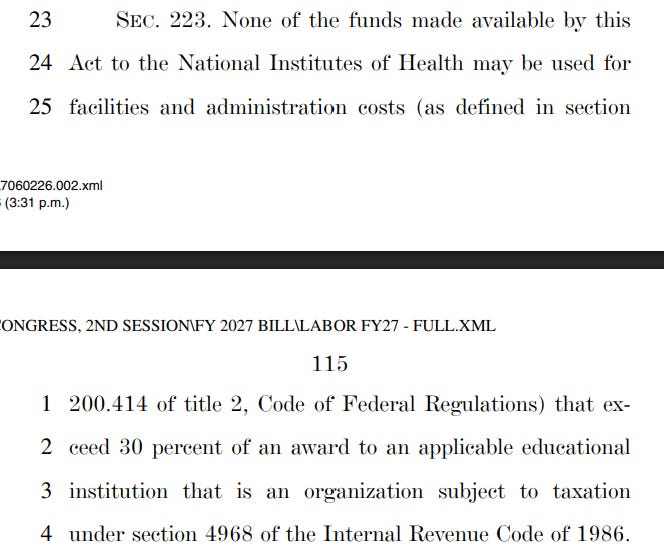
Section 4968 of the Internal Revenue Code is about taxing universities with huge . . . tracts of land (or, more broadly, endowments).
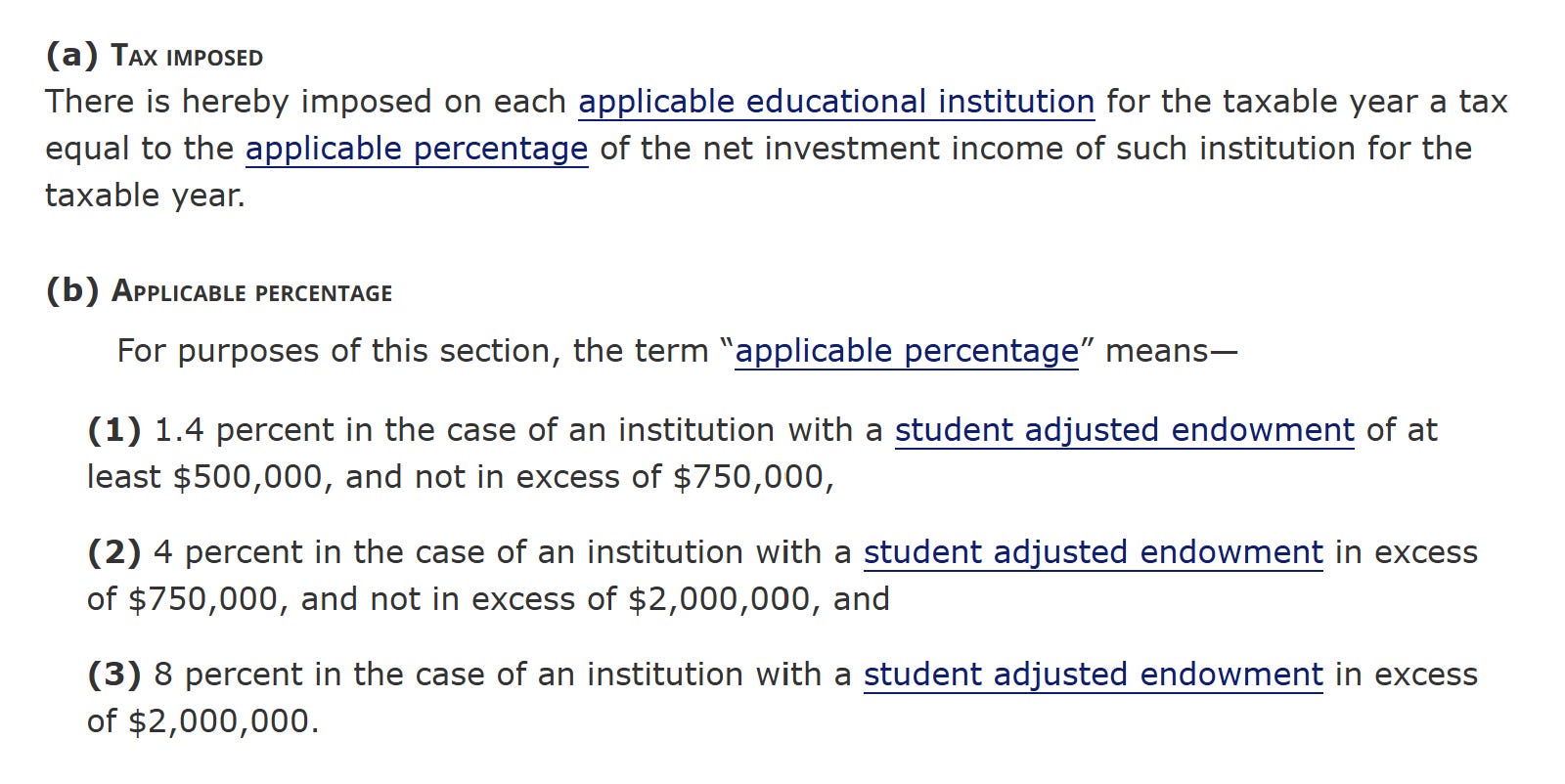
It’s not clear how much this requirement would even matter, given that it defines indirect costs as a percentage of the award, not as a percentage of the direct costs (which is the usual, albeit misleading, formulation). And given that effective indirect cost rates are already in that neighborhood, a 30% ceiling might not matter even for the wealthiest universities.
Anyway, on to the report language accompanying the bill, where there are a number of instructions that might affect the quality of the science we’re funding.
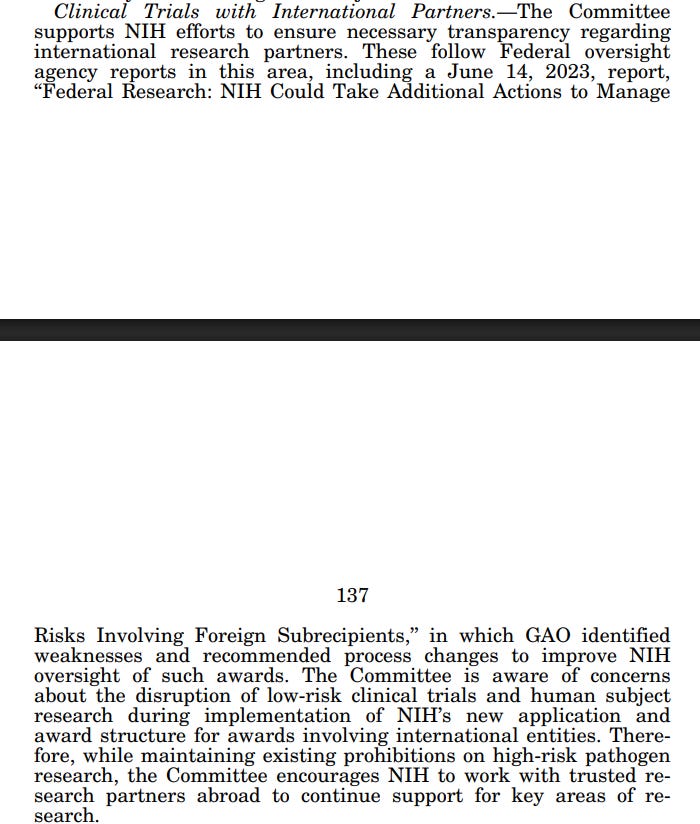
First, there is the issue of clinical trials that involve international partners. While we might occasionally need more oversight and control over such partnerships, they are often immensely valuable. The House recognizes that tradeoff:
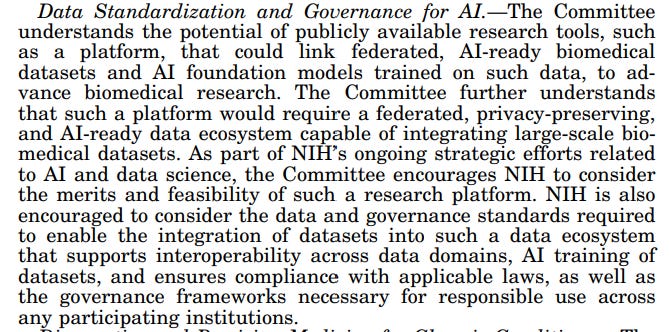
Second, a very different issue is how to provide AI models with access to a secure but useful data platform, NIH should be much more proactive in this direction:
Third, there’s the issue of how to encourage more diversity amongst the institutions that receive federal funding:

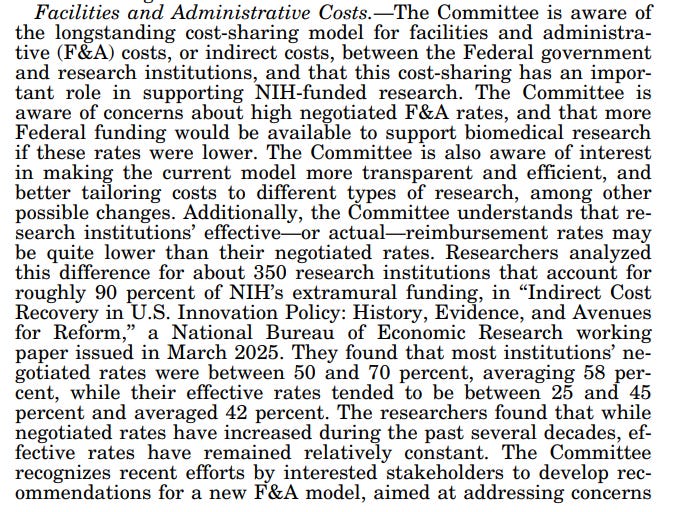
Fourth, the infamous indirect cost issue. This is still a lingering cause for many people, and the answer is yet to be determined. The House weighs in as follows:

Fifth, the issue of administrative burden, about which we have written many times.

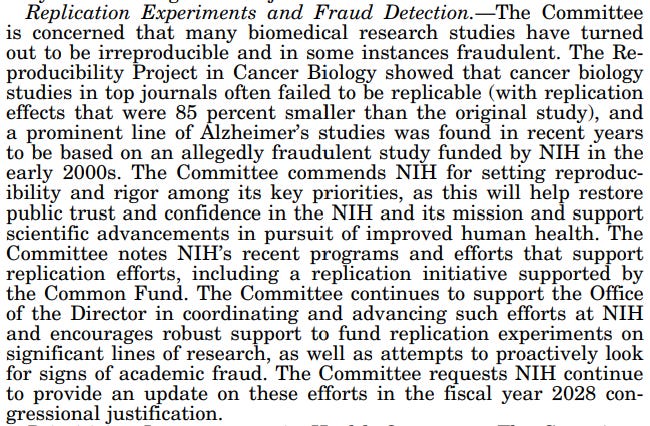
Sixth, the issue of replication experiments and fraud detection, which remains important:
All in all, it is good to see that the House Appropriations Committee is engaging with metascience issues coming from places like the Good Science Project and others.
Not sure all of the interference into the practice of science, especially the arbitrary award of grants by the director and the bypassing of peer review, are good developments. Geographic balance in funding, however, was always a target for federal agencies. And overhead or indirect costs was always a political football from administration to administration—it varied. So these proposals are a mixed bag. Coupled with the proposed new OMB “rules”, the overall impact on science, though, is discouraging and in a downward direction.