

This is a guest column from Christopher Marcum. He is a friend of the Good Science Project and an open science advocate who has held senior positions in both the White House and the National Institutes of Health. Dr. Marcum is writing solely in his personal capacity.
As with all guest columns, the Good Science Project is publishing this because it is important, not because we endorse or agree with every idea or statement.
***
The relationship between the Office of Management and Budget (OMB) and the National Institutes of Health (NIH) may be becoming increasingly fraught. We recently saw reports of fireworks between OMB Director Russell Vought and NIH Director Jay Bhattacharya in the Oval Office over Vought’s move to exercise more control over what NIH grant proposals get funded. Last year, we also saw episodes of impoundments by footnotes, grant cancellations, and plans to limit indirect costs to the de minimis 15%. Those were mostly examples of the influence of OMB’s “B” - or budget - side, although the reform to indirects rested in the “M” - or management - side of the small but mighty agency.
But now there’s evidence that OMB’s control over NIH in the last year has increasingly been exerted through the soft powers of OMB’s “O” side: the Office of Information and Regulatory Affairs (OIRA), which is my former office within OMB where I did both science and statistical consulting for the NIH desk officer.
According to data the public can access on OIRA’s website, reginfo.gov, it has become clear that OMB has started reviewing a large volume of mundane policy documents from the NIH using its authorities under the Clinton-era Executive Order (EO) 12866 (1993). This EO governs the deliberative regulatory review process and is designed to provide the Executive Office of the President, as well as all other federal agencies, a chance to evaluate significant regulatory actions proposed by another agency before they are distributed to the public so that the interagency can align on policy and minimize regulatory conflicts.
As Cole Donovan and I have written, the EO 12866 process can also be used to intentionally slow down policymaking through interagency friction and added bureaucracy. EO 12866 is typically not used for minor documents such as requests for information and internal facing policies, such as the Request for Information (RFI) on Proposed Changes to Reporting Outcomes from NIH Peer Review (RIN 0925-ZA16) and the FY 2026-2030 NIH Strategic Plan for HIV and HIV-Related Research (RIN 0925-ZA20).
But that is exactly what is happening this year.
The NIH has historically benefited from relative independence from regulatory review because the NIH is not a regulatory agency. Yet in 2026 alone, the NIH submitted 12 documents to OIRA for EO 12866 review. All but one of these reviews have concluded.
Prior to this year, the last time the NIH sent materials to OIRA for regulatory review was ten years ago in 2016, and that was for clinical trial reporting requirements associated with an actual regulation at 42 CFR Part 11.
Looking at the entire 45-item NIH docket extending back to 1990, 27 percent of those documents were submitted in 2026. Most of the previous documents submitted to OIRA prior to 2026 were about annual reporting requirements and many were duplicate submissions due to updates needed to the docket. Furthermore, NIH requests for information have never previously been reviewed by OIRA under EO 12866. Now, it appears all of them are being reviewed.
It’s possible that this new interest in non-regulatory documents by a non-regulatory, science funding agency, is just characteristic of the Administration’s zeal for centralized control over all policy (a feature of Unitary Executive Theory and one where EO 12866 has been previously implicated).
That proposition, however, fails when comparing NIH’s docket to one of its peer agencies, the National Science Foundation (NSF), even though NSF has also faced increased encroachment of OMB political control. The NSF promulgates many similar types of non-regulatory documents as the NIH, including requests for information and internal policy documents, and has continued to do so over the last year.
But, unlike the NIH, the NSF has only had a single document undergo OIRA review under EO 12866 in 2026, an actual rare regulatory action taken to make its Title VI regulations conform with EO 14281 on “Restoring Equality of Opportunity and Meritocracy”.
The only time an RFI was sent by NSF to OIRA for review was in 1993, shortly after when EO 12866 was signed and it was about proposed changes to the same Title VI rules. The NIH is clearly being treated differently.
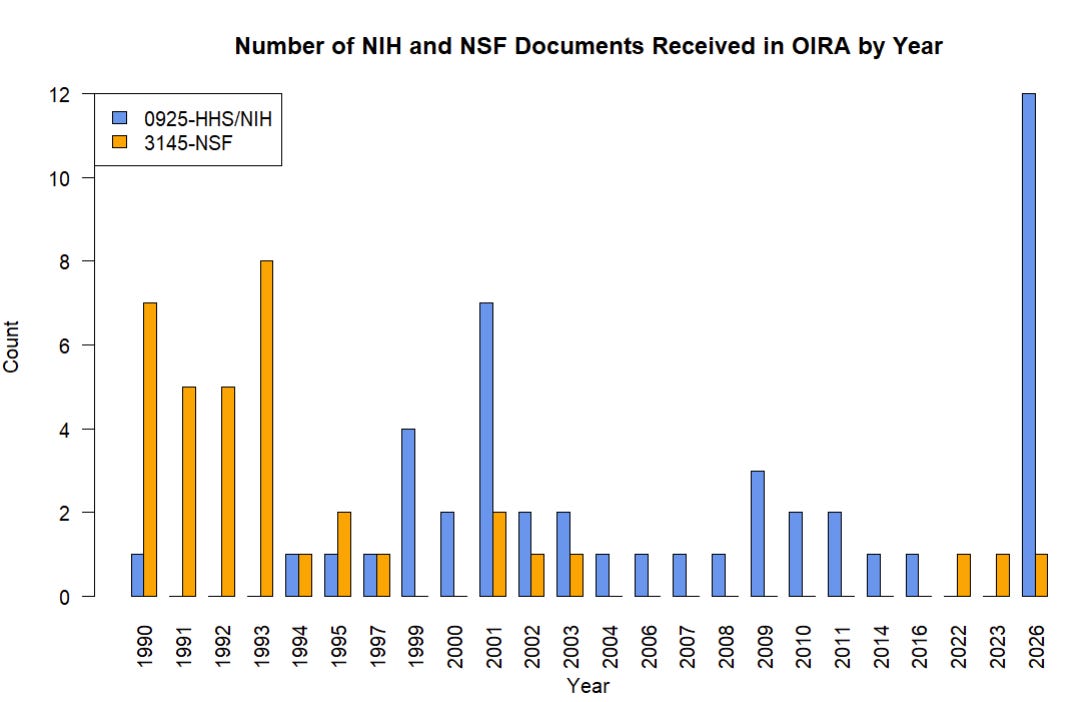
[As reginfo.gov can be cumbersome to use, I’ve uploaded the code and data used in this analysis here to my github.]
Bringing mundane policy documents into OIRA for regulatory review has real consequences. Delayed policymaking slows NIH innovation and its ability to implement even the Administration’s own priorities (ahem, the Draft NIH Biosafety Policy for Research Involving Biohazards was in OIRA for regulatory review for 3 full months (RIN 0925-ZA13) despite having no effect on interagency equities whatsoever).
Also, the scientific community has been waiting for a policy on using grant monies to pay for article processing charges (APC) to publish NIH funded research since last fall. OMB surprised the community with language in the President Budget Request banning spending on scientific publications across the government. Then, we saw similar language appear again this past summer in the unpopular proposed uniform guidance regulation from OMB.
The NIH APC proposal does not appear in the OIRA regulatory docket, perhaps because NIH has been told to hold off until submitting while OMB figures out what it has authority to do to limit funding of science. This sequence of events sows confusion among the public and the scientific community about where the actual policy stands - all for something that would only affect NIH grantees in the meantime.
Applying EO 12866 to these commonplace agency documents waters down the importance and the effect of the regulatory review process in general. The executive order was intended to cover rules with major economic and policy impacts, and to coordinate interagency consensus around a rulemaking.
Subjecting the NIH to an entirely novel tier of bureaucratic review demonstrates that the conflict between Russell Vought and Jay Bhattacharya extends beyond Oval Office meetings and into the daily machinery of federal science policy.
It’s an impoundment of policy, rather than budget, by OMB.
