

Lots of great reading material just in the past week:
1. On moonshots: Leya Mohsin, “The Science of Moonshots: Using Evidence to Design Transformative Initiatives” and Tom Kalil, “The Role of Philanthropy in Identifying and Pursuing AI Moonshots.”
The first item here arose out of a Federation of American Scientists event called “Moonshots for Metascience, and Metascience for Moonshots” (I was a panelist). Mohsin makes several good points:
The term “moonshot” is often seen as “tired, overused, and overhyped,” because it has been used so often as a “marketing term . . . rather than a specific term used to describe a program with a discrete structure and objective.”
Truly successful moonshots (like the Apollo Program or the Manhattan Project) had a very clear definition of the end goal and of exactly how to get there.
Organizational governance matters immensely, with examples being DARPA’s “concentrated decision-making authority combined with clear accountability to a defined endpoint.”
We need more metascience here: “Metascience can help us understand not just what topics might be ripe for a moonshot, but also how to best run those initiatives.”
Tom Kalil’s piece, in turn, fleshes out how philanthropy could support moonshot efforts in AI. Check out this chart for some inspiring ideas:
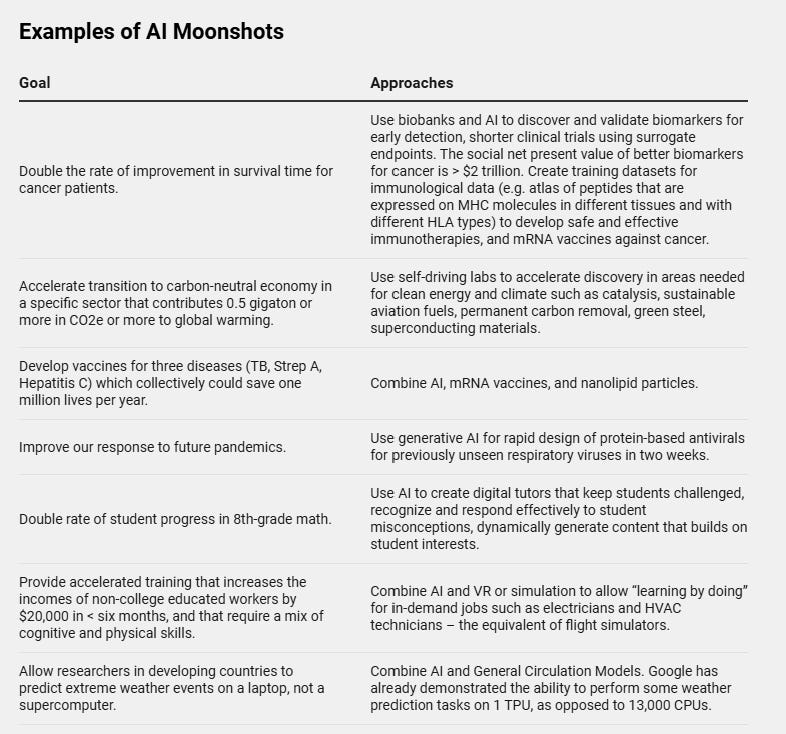
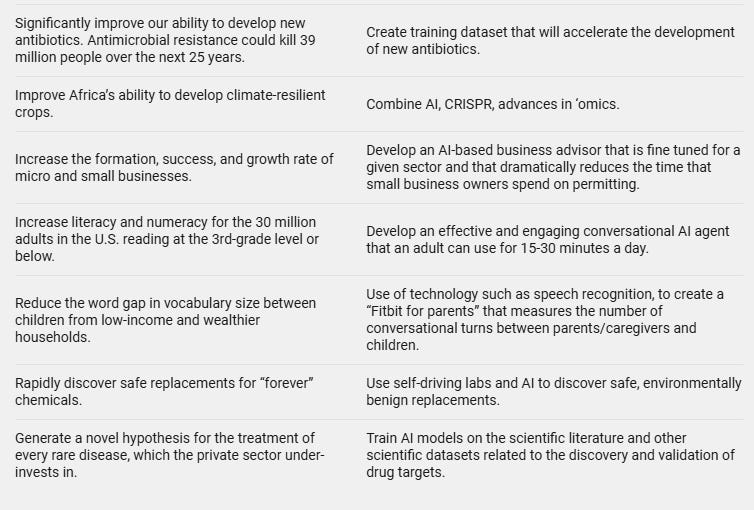
Kalil then gives advice on how philanthropists should tackle these types of problems, such as what sorts of people they should hire and how they should evaluate success.
Daniel P. Gross, Bhaven N. Sampat, and Hansen Zhang, “Retreating from Science: The Long-Run Effects of the 1970s U.S. Military Disinvestment from University Research.”
This article looks at a large reduction in R&D spending by the Department of Defense some 50 years ago:
In this paper, we study what is perhaps the largest contraction in science funding in U.S. history: the Department of Defense’s (DoD) retreat from science in the 1970s. For the first 25 years after World War II, the U.S. military was the world’s largest sponsor of university research in the physical sciences and engineering, comparable to the National Institutes of Health’s (NIH) scale in the life sciences. . . . In the early 1970s, however, the political consensus for military-funded university research collapsed, amid the tensions raised by the Vietnam War. Congress subsequently put significant restrictions on what research the military could fund and reduced its budget. By the mid-1970s, DoD’s university research contracts had declined nearly 70% in real dollars from their late 1960s peak, and since then have never fully recovered.
This piece is a monumental effort at data collection and analysis:
Underlying this analysis is a new dataset we develop measuring the U.S. postwar university research system, and the military’s place in it. Roughly a dozen data sources contribute to our measurement, which we focus around 1960 to 1990. These include contract- and grant-level data for DoD and the National Science Foundation (NSF); university-level financial data; individual-level data on scientists and PhD graduates; and records of publications and patents. Crucially, information from one of these historical datasets—the NSF’s National Register of Scientific and Technical Personnel—allows us to identify DoD-funded university scientists in 1970 (on the eve of the military’s retreat from science), which provides us a measure of exposure and we can use directly or aggregate. Linking these data sources to common identifiers, we construct several analytical datasets, including university-year, university-field-year, individual-year, country-field-year, and technology-year panels, where we can measure changes in scientific research, technological innovation, and training over time—the three core outputs of the modern research university.
The results of such a sharp reduction in spending?
Identifying universities, fields, and individuals who were relatively more dependent on DoD research support in 1970, and therefore more exposed to the post-1970 contraction in DoD research funding, we examine post-1970 trajectories in these outcomes in relation to this exposure. Broadly, we find that after 1970, science contracted significantly in the universities and fields DoD was supporting: publications and PhD training declined, and DoD-funded early career scientists became more likely to leave the academy. At the national level, publication output in traditional DoD-supported fields declined relative to other countries, compressing U.S. leadership in global science in these fields. Nationwide science-linked innovation in technology areas most exposed to these cuts declined as well, indicating that the effects of funding cuts extended beyond universities and into downstream sectors.
This paper has implications beyond just Defense R&D spending, e.g., current attempts to decimate NSF by firing nearly half its employees (already done) and attempting to cut its budget nearly in half.
Dan Turner-Evans, “Picking the Right Challenge for Genesis Mission.”
The Genesis Mission is an ambitious effort at the Dept. of Energy to accelerate AI in science. But likely far too ambitious. Turner-Evans contends that the Genesis Mission’s 26 challenges/goals are too many for any actual moonshot effort (see the “moonshot” papers above!)
Turner-Evans’s recommendations include narrowing in on a smaller set of clearly defined goals, and focusing on areas “where the federal government adds unique value: basic science, classified research, and national coordination challenges like the electrical grid.”
Couldn’t agree more.
[Since I wrote this text on Monday, the Genesis Mission has gone in the opposite direction by expanding to include other agencies and more priorities and goals.]
More broadly, though, not enough people have been publicly questioning why the Genesis Mission is at DOE in the first place, or how well it is actually doing. A friend who has personal experience here thinks that Genesis is unimpressive so far, but isn’t willing to say anything publicly because his organization is applying for funding. (The paradox of harmful information strikes again . . .)
For example, this promotional video from Genesis seems to be advertising things for which quantum computing couldn’t possibly be all that useful. My friend said, “there is no need to use 'agentic AI with quantum computers’ to model the extraction rate of hydrogen.” My personal heuristic is that if you’re legitimately doing great work, you don’t need to engage in exaggeration or hype.
He added, “if you spend any time looking at the national labs, you will be so blackpilled.” Another person who worked at one of the national labs said that while they still do some “fantastic projects,” they have “overall lost their way”—instead of focusing on “high-risk and forward-looking research,” they have become “a place where the professionalization or career-ization of science has almost become like LinkedIn, where people advertise their work more than doing real work.”
In his words, “Many people publish one paper a year, and have a few additional figures from the previous paper, and the new paper is completely uninteresting and marginal. The quality and innovativeness of the work I saw was simply painful.” He also noted that the administrative burden at the labs is worse than at universities, and that he knows a number of physicists who do “nothing but paperwork” and “hate it.”
Moreover, the National Labs have a number of high-profile projects that have experienced huge delays. For example, a major experiment at FermiLab is a decade behind schedule due to a vendor’s failure to deliver a magnet.
Another example: DOE has been running something call the National Spherical Torus Experiment (or NSTX) since 1999 (since 2012, it has been called NSTX-U, with the U standing for “upgrade”). In simple terms, it is a device that attempts to study magnetic fusion.
The project has actually been shut down since at least 2016. From Wikipedia: “The NSTX-U (Upgrade) was stopped in late 2016 just after its update, due to a failure of one its poloidal coils. The NSTX had been shut down since 2012 and only returned for 10 weeks at the end of 2016 just after it was updated.” To this day, its website says:

Yet DOE budget documents regularly use language like the following: “The DIII-D National Fusion Facility and the National Spherical Torus Experiment-Upgrade (NSTX-U) facility are world-leading Office of Science (SC) user facilities for experimental research, used by scientists from national laboratories, universities, and industry research groups.”
An interesting choice there: to ask for nearly $100m in 2025 for NSTX-U (see page 4 here) and around $50m a year since (page 18 here), and to describe it to Congress in both of those budget docs as a “world-leading . . . facilit[y] for experimental research,” even while it has been shut down for a decade.1
It is possible that the above is unfair in some respects, but given the systematic incentives for anyone with insider knowledge to keep quiet, investigative journalists and congressional staffers might want to dig deeper here.
4, M. Anthony Mills, “Who Should Decide How to Use Taxpayer Dollars to Fund Scientific Research.” Tony Mills addresses the recent moves by the White House to fire the entire National Science Board (which governs the National Science Foundation) and to issue a proposed rule giving political appointees the ability to cancel grants for not being consistent with the President’s priorities. Mills is typically thoughtful and deeply grounded in history, and concludes that while the White House’s actions might be overly agressive, Congress “must avoid the temptation of retrenchment,” because "the “federal research enterprise should be democratically accountable.”
***
Finally, the Metascience 2027 Conference has been formally announced: June 14-16, 2027 in Montreal. Sign up here before it’s too late.
A couple of insiders told me that the delays have been due to a number of issues—a magnet installation, a problem with insulation, and an overall culture of safety and risk aversion.