

by Aishwarya Khanduja (Analogue Group) and Stuart Buck (Good Science Project)
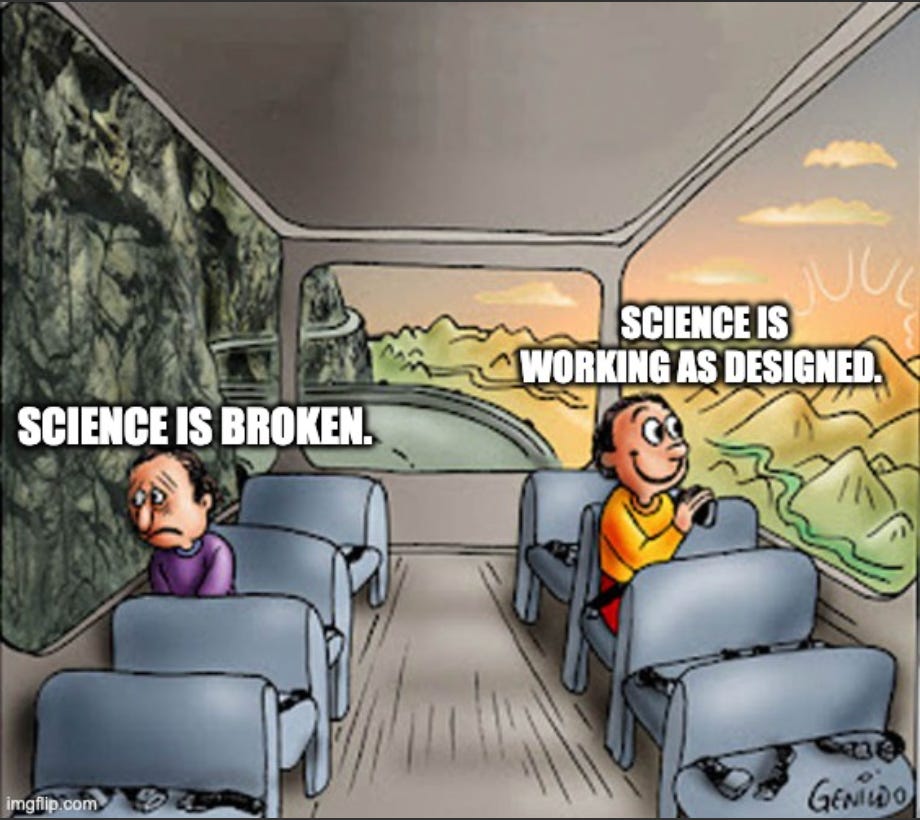
For more than 80 years, economics has distinguished between microeconomics (how individual actors make decisions) and macroeconomics (how those decisions aggregate into large-scale patterns).1 This distinction has proven so valuable that we’ve forgotten how confusing economics was before it.
This micro/macro distinction enabled different methodologies, different types of evidence, and different policy levers. It revealed that what happens at the individual level can look very different when aggregated up to emergent, large-scale, societal patterns. Microeconomics and macroeconomics require different tools, ask different questions, and often reveal different truths.
Metascience needs the same clarity. Just as economics is about how incentives work in the marketplace for goods and services, metascience is about how incentives work in the marketplace for ideas and truth-seeking. And these incentives play out at the same micro- and macro-levels.
The Problem: Everything Is “Metascience”
Up to this point, “metascience” has been a broad and diffuse category, embracing everything from efforts to improve journal policies on preregistration, to large-scale analyses of citation patterns, to thought pieces on how NIH should change its grantmaking, to fraud detection and reproducibility studies, to ethnographies of labs, to launching new scientific organizations like Convergent Research or Speculative Technologies.
All of the above (and more!) has been lumped under one umbrella. This creates confusion about what metascience actually is, what methods it should use, and how different metascience efforts relate to each other. We’re trying to repair an epistemic economy without naming the fact that there is an economy, and that economies have both large-scale markets and individual minds.
Like financial economies, epistemic systems involve resource allocation (attention, funding, prestige), exchange mechanisms that create incentives (citations, collaborations), and trust (peer review, replication).
And like financial economies, individual rationality can produce collective irrationality. A scientist making the individually rational choice to avoid risky projects can contribute to a collectively irrational system where no one pursues breakthrough ideas.
To help clarify things, we should think of metascience at multiple levels, just like economics. If metascience were software, we’ve been trying to fix bugs in the user interface while ignoring the operating system (or vice versa).
The Distinction
Macro-metascience is about the political economy of funding, conducting, and publishing science at scale. In other words, it is about the large-scale policies and funding mechanisms that affect incentives, governance, institutions, etc. that make progress possible (or, in many cases, more difficult). This is the domain of the Good Science Project and other aligned organizations (such as the Institute for Progress or the Federation of American Scientists), that work on reforming federal agencies, redesigning grant mechanisms, and proposing journal reforms. Macro-metascience asks questions like: How should NIH structure peer review? What funding mechanisms best support high-risk research? How do citation patterns reveal bias versus creative innovation?
Micro-metascience, by contrast, is about individual scientists and the experience of discovery, i.e., how researchers actually experience reasoning, who they trust or doubt (and why), the mimetic pressures inside research groups, the ways in which they form conviction about evidence, and how they generate creative ideas. This is where Inês Hipólito’s work on cognitive and social epistemology and Omar Shehata’s work on mimetic engineering can shed light on how individual scientists navigate their intellectual environments.
Consider a concrete example of micro-metascience in action. If you’ve ever hung out at the hotel bar at a scientific conference, you will often hear some thoughts along the following lines: “Don’t quote me publicly, but no one really trusts such-and-such superstar in my field. We just can’t get that lab’s work to replicate.”
This gap between what scientists know privately and what they can say publicly is a micro phenomenon with macro consequences. If trust is created primarily through gossip rather than through publications, entire fields can be infected with unreliable methods and findings because no individual scientist will safely speak up to say that the emperor has no clothes. From the outside, the macro-level system may seem functional with lots of papers, citations, and grants, while the micro-level reality is epistemic dysfunction that only a few insiders actually know about.
The Distinction in Operation
This distinction reveals why so many well-intentioned metascience reforms can fail. They are aimed at only one level while ignoring the other level or merely assuming it will all go well.
As in economics, large-scale initiatives and reforms often ignore the cultural and psychological effects on individual scientists. You can redesign a national grant program, but if individual researchers inside the system are operating out of a mindset of fear, scarcity, or reputational risk, the reform may not work or could even backfire.2 Conversely, you can start a mass movement to encourage individual scientists to follow their curiosity, but if universities are less favorable towards early-stage exploration that “failed,” then individual scientists will behave as you would expect given their incentive to keep their jobs.
Take preregistration. At the macro level, preregistration at one time seemed like an obvious solution to publication bias and p-hacking, with idea being to require researchers to commit to hypotheses and analysis plans before seeing their data. Many journals and funding agencies have adopted preregistration requirements by this point.
But the micro level arguably tells a different story. If individual scientists are afraid that preregistration might increase their chance of a null result and thereby lower their chance of publication, they may instead try to game the system by preregistering every potential hypothesis and outcome.
Indeed, this is arguably what has happened in some fields: researchers submit vague preregistrations that allow maximum flexibility, or they preregister multiple analysis strategies and then selectively report the ones that “worked.” A macro-level intervention is therefore less effective than anyone anticipated because it didn’t account for how individual scientists would actually experience and respond to the new requirement.3
Similarly, let’s thinkg about national initiatives to sponsor so-called “high-risk, high-reward” research (a term that we dislike).4 At the macro level, agencies like NIH or NSF have created special funding programs specifically calling for such “high-risk” research. But at the micro level, if these programs are viewed cynically by individual researchers who submit work they have already completed (because that’s the only way to make it seem “safe” enough to get funded), then the initiative may not have its intended impact.
After all, researchers will respond rationally to their perception that “high-risk” is actually code for “we’ll still only fund things that look exciting but also highly likely to succeed.” We are aware of one scientist who took a close look at the NIH’s Pioneer awards (intended to sponsor ambitious scientists to take a “new scientific research direction”), and who found that most or all grantees were actually continuing the same research direction as before.
Perhaps the most powerful example is Katalin Karikó’s decades-long struggle to develop mRNA therapeutics. At the macro level, institutions repeatedly rejected her work: she was demoted and was told her research had no future. The macro-level system—with its emphasis on immediate results, conventional approaches, and established paradigms—couldn’t recognize the value of her exploration.
But at the micro level, Karikó’s individual persistence ultimately led to one of the most important medical breakthroughs of the 21st century (and a Nobel Prize). The interaction between these levels is crucial: whether a university or NIH will tolerate uncertainty will then affect an individual scientist is willing (or not) to persist with unpopular ideas. How many potential Karikós gave up because they lacked her combination of stubbornness, self-belief, and tolerance for professional humiliation?
The superstar economist Raj Chetty has written about “Lost Einsteins,” as in people who had the potential to be a scientific genius but never got the necessary education. Perhaps we also need to focus on “Lost Karikós,” as in scientific geniuses who did get the right education but were failed by the system.
Another example of how the two domains interact: A micro-metascientist might work with individual scientists to determine how disagreement affects someone’s willingness to undertake outside-the-box research, i.e., measuring things like psychological safety, the formation of trust (or not!), and willingness to share informal ideas. A macro-metascientist might redesign the NIH process to fund more outside-the-box research by changing how peer review ratings are scored, perhaps implementing variance-based selection where proposals with both very high and very low scores get funded.
These sorts of questions must be studied together, because the feedback loops between levels will determine what actually happens and whether an intervention works.
Comprehensive Metascience
A comprehensive theory of metascience would recognize that:
High-level policy, governance, and funding decide what even what counts as “science” in the first place. For example, the NIH’s emphasis on “significance” and “impact” forces researchers to frame exploratory work as if it already has clear applications. This requirement asks scientists to talk about supposed real-world applications before they are even able to understand the basic mechanisms at issue. The macro-level requirement thus shapes the micro-level experience of how scientists imagine their own work.
Local culture determines how individual scientists react to national policies, and in turn, whether their day-to-day behaviour is likely to lead to breakthroughs. When researchers internalize the message that only positive results are publishable or fundable, they will consciously or unconsciously avoid research ideas that might yield null results, even when those would be highly useful to the field. Even worse, they will be tempted to engage in questionable research practices (sometimes rising to the level of fraud). That gives us the worst of all worlds, in which people study marginal questions and then exaggerate the results (rather than studying big questions and telling the truth about their failures).
The interaction between levels creates emergent dynamics that can’t be predicted from either level alone. A scientist who is devoted to humility (a micro-level virtue) and the pursuit of breakthrough ideas might be employed by a series of universities that, for all practical purposes, punish negative results (a macro constraint). That scientist can experience cognitive dissonance between their desire to do great research and their desire to hold down a job. Maybe they leave science, maybe they become cynical, or maybe they find ways to pursue their curiosity in the shadows. In any event, we can’t understand the system if we only focus on one level at a time.
This piece is an attempt to understand the structure of the scientific system. If economics needed micro and macro to understand markets, science needs micro and macro to understand how to improve itself.
The Practical Implications
Recognizing the micro/macro distinction has practical implications for anyone who wants to improve science (including ourselves).
First, there is a gap that has caused many failures: nearly every metascience intervention operates at only one level. Reformers either redesign incentive structures from the top down while assuming scientists will respond as intended, or they train scientists in better practices while ignoring whether institutions will reward those practices. The micro/macro distinction makes this gap more explicit, and tells us why we should want our policies and interventions to address both levels simultaneously.
Second, we think we now have a more useful framework for understanding why reforms fail. When a seemingly well-designed macro-level intervention doesn’t produce the results we hoped for, we should ask questions like, “What is the individual experience of the scientists in the system? What are their fears, their incentives, and their sources of trust and creativity?” By asking those types of questions, the failure point would then become more visible.
Third, we are suggesting that effective interventions should ponder three questions ahead of time: 1. What are the macro-level constraints? 2. How will individual scientists experience these constraints? 3. What feedback loop operates between the two levels? Only when we can answer all three questions do we understand the system we’re trying to change.
This means, for instance, that designing a new funding mechanism requires both macro-level analysis (how does this change incentives? how does it interact with other funding sources? what behavior does it reward?) and micro-level understanding (how will scientists perceive this mechanism? what will it feel like to apply? who will feel comfortable using it versus who will self-select out? how will it affect scientists’ willingness to take risks?).
Conclusion: Designing for Both Levels
A new understanding of science and metascience is possible. Most importantly, good science doesn’t arise merely from having systems that look the best from a top-down perspective. The most well-designed funding mechanism may run aground if the local culture is one of fear, scarcity, and ferocious competition for grants. The most brilliant peer review process can’t manufacture individual scientists who have faith in their own judgment and are willing to pursue unpopular ideas.
Ultimately, good science is produced by individual people and small teams that are all embedded within larger systems. And if we want better science, we have to design for both levels, the micro and the macro. We need to understand how policy shapes personal experience, and how personal experience in turn affects which policies are feasible.
The micro/macro distinction gives us the language to do this. It’s time metascience became as sophisticated about its own structure as economics has been about markets. We have the macro tools, such as policy reform, new funding mechanisms, new institutions, and more. We’re developing the micro tools: understanding how trust and psychological safety emerge, and how creative impulses are given the freedom to exist.
We need to work on both levels. Only then can we build the epistemic economy we need one that, produces not just more science, but better science, breakthrough science, science that actually helps us understand the world.
The terms were first defined in a 1941 article as analyzing economic concepts “for a single person and family” versus “for a large group of persons or families (social strata, nations, etc.).”
Stuart was told privately by a top Alzheimer’s researcher that the Alzheimer’s field was probably more robust before Congress started allocating so many billions of dollars to it. In his words, “Now every neuroscientist puts the word ‘Alzheimer’s’ in their grant proposal no matter what they are actually studying.”
A researcher at a top university told Stuart privately that in his experience, graduate students started writing 100+ page analysis plans that were so boring and tedious that no one would ever read them, thus allowing the students to later engage in whatever analysis they wanted.
Almost no research is actually “high risk” to anyone but the individual scientist, who is at risk of losing salary, publications, and even a job if they try to tackle an ambitious problem.

really proud of this one!
Great observation! I hope someone is listening.