

The Senate Appropriations Committee just released the Fiscal Year 2027 bill for HHS (and hence for NIH), along with explanatory language directed at NIH.
Several metascience-related items below:
Supporting Younger Researchers

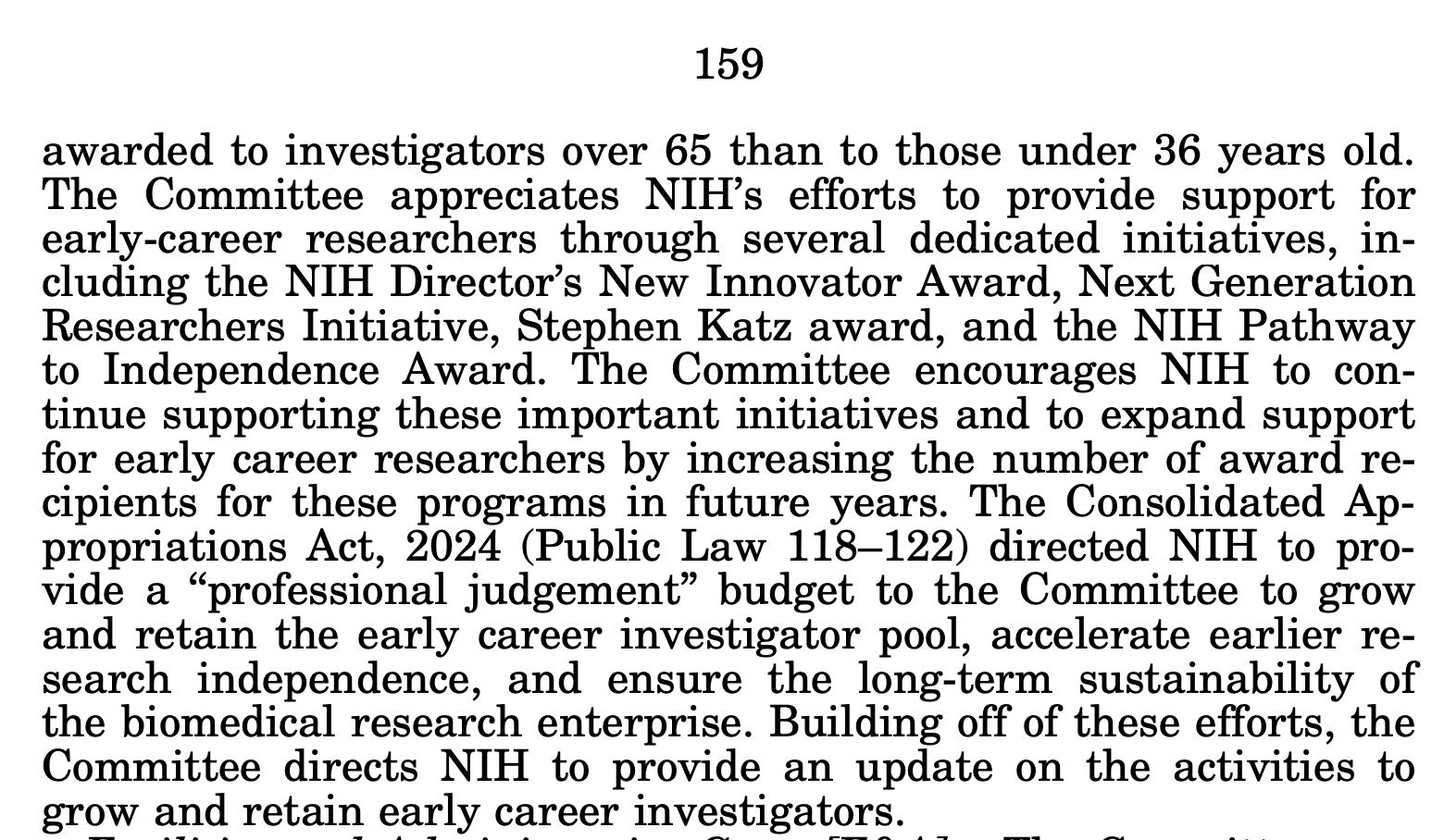
The case for supporting younger researchers (which here means “someone who on the verge of middle age) is strong, and this language has been in NIH appropriations since 2024. Probably time for NIH to start complying with what Congress has asked for!
Indirect Costs
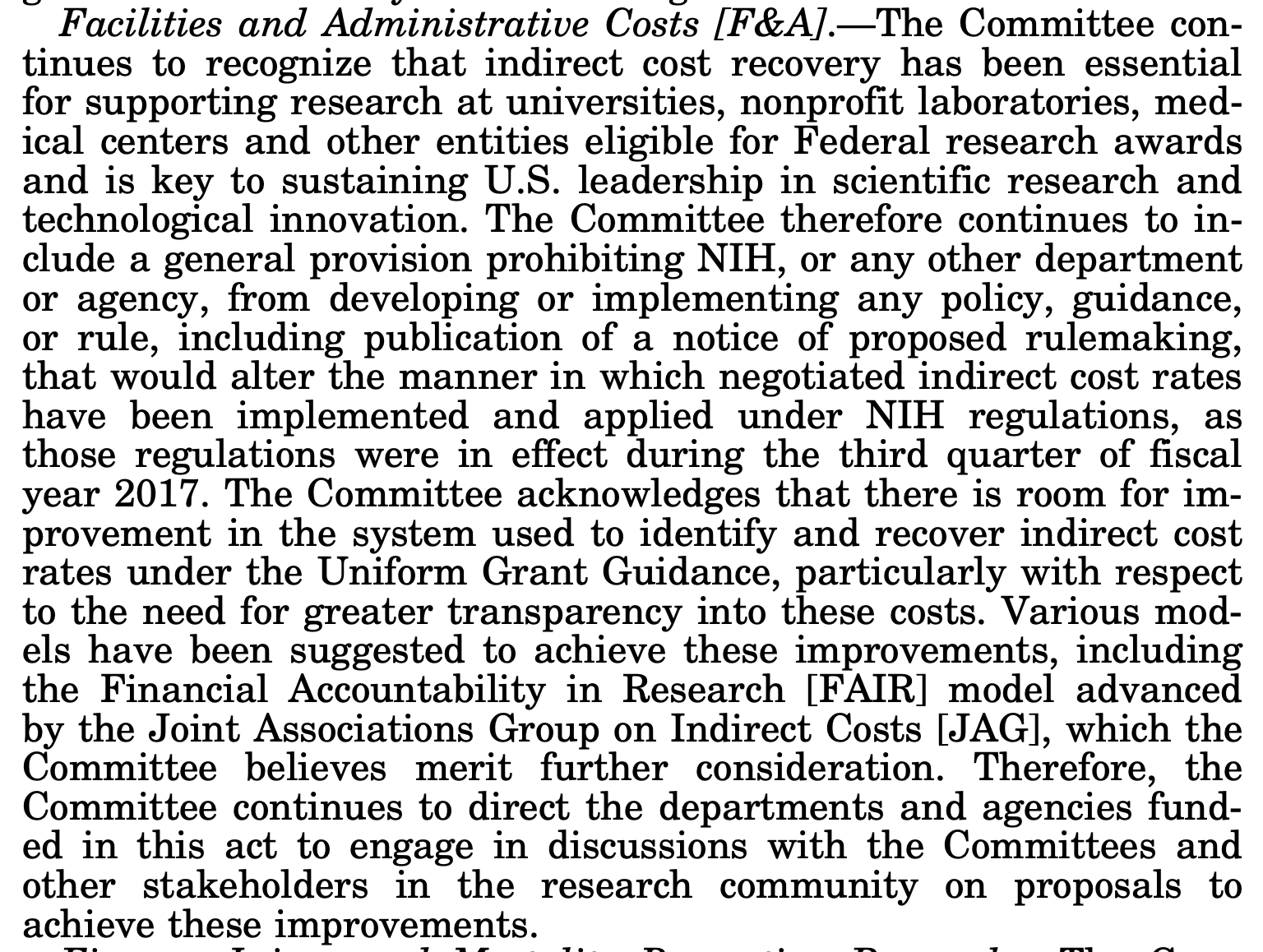
We have covered the indirect cost issue to great lengths before (indeed, ad nauseam). See, e.g., here and here. Good to see that the Senate is still in favor of the most sensible alternative approach to indirect costs.
Multi-year funding of research grants
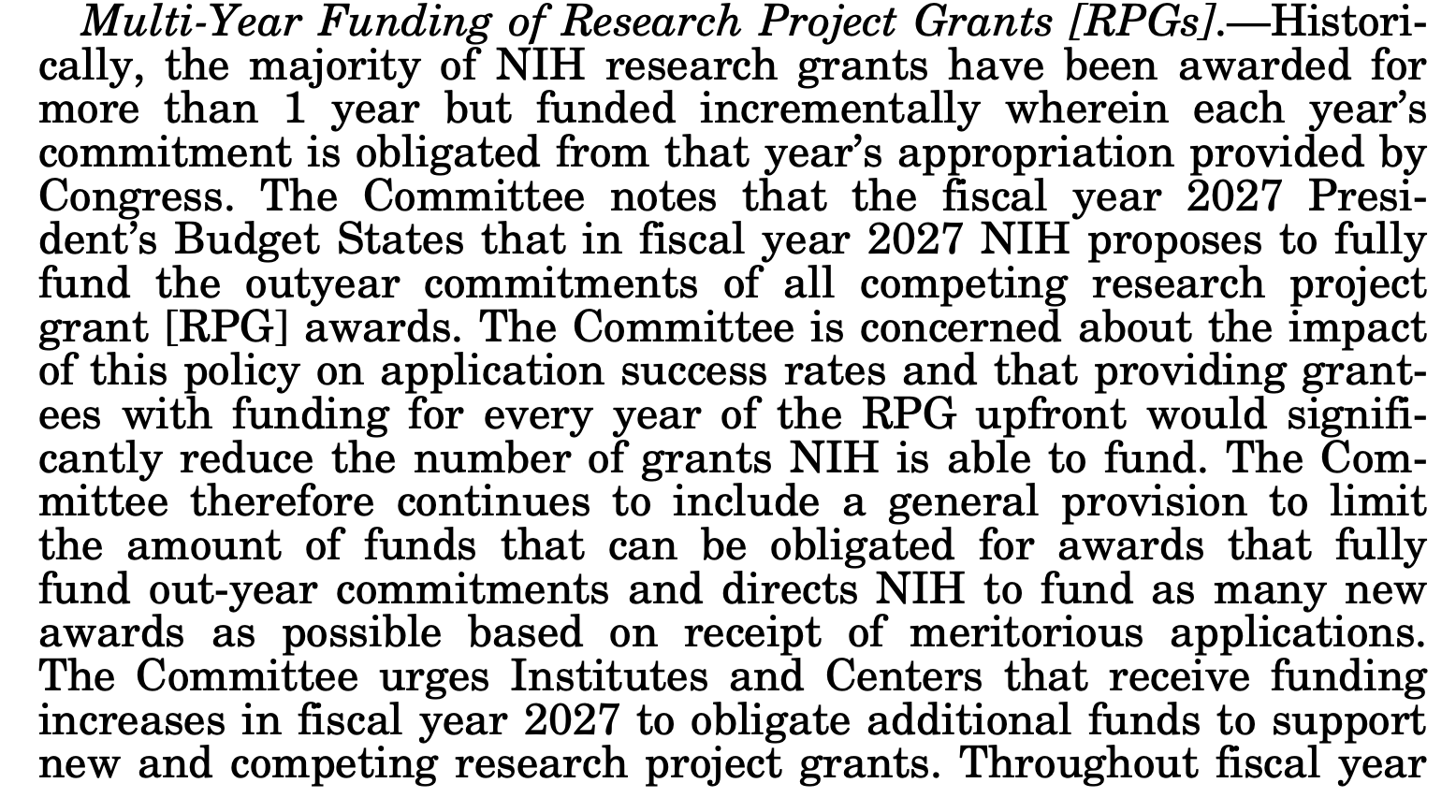

Multi-year funding is one of those issues where, in principle, it makes sense to use a particular approach, but there isn’t an easy way to get there from here.
Up till now, NIH’s budget each year has been mostly 80% towards grant commitments from the previous years, and 20% towards new grants. Funding each grant upfront with 4-5 years of money does make sense, but if you switch from one regime to the other, it will be difficult to say the least!
In year one of that transition, 80% of that year’s budget will be going towards the commitments from prior years, and the 20% for new grants will be entirely taken up with pre-paying for the next 4-5 years—which in turn means very few new grants! Result: everyone gets upset because there are so few new grants that year.
No one has any magic answers here.
Reducing Bureaucracy

I think that is the same language I quoted here, and it would be great if NIH did what it was instructed to do:
Reducing the Administrative Burden on Researchers.–The Committee recognizes that according to a national survey by the Federal Demonstration Partnership, federally-funded researchers report spending 44 percent of their research time on bureaucracy, including the time to prepare proposals and budgets, post-grant reporting of time and effort, ethical requirements, and other compliance activities. Although NIH and other agencies tasked with reducing administrative burden conducted extensive consultations with the research community that resulted in a 2019 final report on their implementation plans, the Committee is concerned about the status of the implementation by NIH and any plans to evaluate the outcome. The Committee directs NIH to form a Board on reducing administrative burden, with at least 75 percent representation from non-Federal organizations and at least 25 percent representation from early-career researchers (including post-docs). Within 1 year of enactment, the Board is directed to provide a report that includes an evaluation of current efforts to reduce administrative burden and to provide recommendations aiming to reduce the administrative burden on researchers by 25 percent over the next 3 years. The Committee strongly encourages NIH to put recommendations into effect as soon as practicable. The Committee requests a briefing on this effort 90 days from the enactment. The report recommendations shall be made available to the public on the agency website.
Replication and Fraud

Senate Report 119-55 is here, and what it said about replication is this:

NIH-funded research needs more replication. The NIH has been trying to stand up an Office for Replication and Reproducibility, but it still needs to comply with what Congress has been demanding since 2024.
The Scientific Management Review Board


This is the board that, under the NIH Reform Act of 2006, is supposed to regularly measure NIH’s performance and publish reports to Congress on NIH’s performance and whether it should be reorganized. The board was left dormant for several years because Francis Collins didn’t want to bother with it (at least so I hear). I told a journalist a few years ago to look into it, with the result being this article. I also told several congressional staffers about this board, and they sent a letter to NIH demanding an explanation.
Long story short, NIH restarted the board. But that was just a start—has the board actually done anything meaningful since then? Hard to say. Congress should keep pressing NIH on this point. Former NIH Directors have said that this statutory tool to organize NIH should have been more well-used by now, rather than leaving NIH’s structure basically unchanged for 20 years.